
Evaluation
Set up eval-driven releases with MLflow, quality gates, and 14 automated scorers.
Overview
Recif integrates with MLflow GenAI to provide a comprehensive evaluation pipeline for your agents. Every release can be gated by quality scores, and the platform ships with 14 built-in scorers covering response quality, RAG accuracy, and tool-call correctness.
The 14 MLflow Scorers
Recif uses a registry-based scorer resolution pattern. Each scorer is an MLflow GenAI scorer instantiated at evaluation time.
Response Quality Scorers
| Scorer | Category | What It Measures |
|---|---|---|
safety | Safety | Detects harmful, toxic, or unsafe content in responses |
relevance_to_query | Quality | How well the response addresses the user's question |
correctness | Quality | Factual accuracy of the response against expected output |
completeness | Quality | Whether the response fully answers all parts of the query |
fluency | Quality | Grammar, readability, and natural language quality |
equivalence | Quality | Semantic similarity between response and reference answer |
summarization | Quality | Quality of summarization when the task is to summarize |
guidelines | Compliance | Adherence to custom guidelines provided in the scorer config |
expectations_guidelines | Compliance | Whether response meets specific expected behaviors |
RAG Scorers
| Scorer | Category | What It Measures |
|---|---|---|
retrieval_relevance | RAG | Whether retrieved documents are relevant to the query |
retrieval_groundedness | RAG | Whether the response is grounded in the retrieved context |
retrieval_sufficiency | RAG | Whether retrieved context is sufficient to answer the query |
Tool Call Scorers
| Scorer | Category | What It Measures |
|---|---|---|
tool_call_correctness | Tools | Whether the agent called the right tools with correct parameters |
tool_call_efficiency | Tools | Whether the agent used the minimum necessary tool calls |
Risk Profiles
Risk profiles determine which scorers run automatically during eval-gated releases. Each profile maps to a preset list of scorers.
LOW -- 2 scorers
Minimum quality bar. Use for internal tools and low-stakes agents.
| Scorer | Purpose |
|---|---|
safety | Ensure no harmful content |
relevance_to_query | Basic relevance check |
Minimum score threshold: 60%
STANDARD -- 3 scorers
Default for most agents. Adds factual correctness.
| Scorer | Purpose |
|---|---|
safety | Ensure no harmful content |
relevance_to_query | Relevance check |
correctness | Factual accuracy |
Minimum score threshold: 75%
HIGH -- 6 scorers
Strict quality bar for customer-facing and regulated agents.
| Scorer | Purpose |
|---|---|
safety | Ensure no harmful content |
relevance_to_query | Relevance check |
correctness | Factual accuracy |
guidelines | Custom guideline adherence |
retrieval_groundedness | RAG grounding (if KB attached) |
tool_call_correctness | Tool use accuracy (if tools attached) |
Minimum score threshold: 90%
Golden Datasets
Golden datasets are curated sets of test cases used for consistent evaluation. Each case has an input and an optional expected output.
Create a dataset via API
curl -X POST http://localhost:8080/api/v1/agents/ag_01J.../datasets \
  -H "Content-Type: application/json" \
  -d '{
    "name": "golden-qa",
    "cases": [
      {
        "input": "What is the capital of France?",
        "expected_output": "Paris"
      },
      {
        "input": "Summarize the theory of relativity in one sentence.",
        "expected_output": "Space and time are interwoven and warped by mass and energy."
      },
      {
        "input": "Translate hello to Spanish.",
        "expected_output": "hola"
      }
    ]
  }'
Dataset structure
Each case supports the following fields:
| Field | Type | Required | Description |
|---|---|---|---|
input | string | Yes | The user query to send to the agent |
expected_output | string | No | The reference answer for correctness scoring |
context | string | No | Additional context for RAG evaluations |
metadata | object | No | Key-value pairs for filtering and tagging |
Seed datasets
When you first trigger an evaluation, Recif creates a seed dataset with 5 basic test cases if none exist. Replace these with domain-specific cases for meaningful results.
Triggering Evaluations
Manual trigger via API
curl -X POST http://localhost:8080/api/v1/agents/ag_01J.../evaluations \
  -H "Content-Type: application/json" \
  -d '{
    "dataset_name": "golden-qa",
    "version": "1"
  }'
Response:
{
  "data": {
    "id": "ev_01J...",
    "agent_id": "ag_01J...",
    "agent_version": "1",
    "dataset_name": "golden-qa",
    "status": "completed",
    "provider": "mlflow",
    "aggregate_scores": {
      "safety/mean": 0.95,
      "relevance_to_query/mean": 0.88,
      "correctness/mean": 0.82
    },
    "total_cases": 3,
    "passed_cases": 3,
    "started_at": "2026-04-03T10:00:00Z",
    "completed_at": "2026-04-03T10:00:45Z"
  }
}
On release (eval-gated)
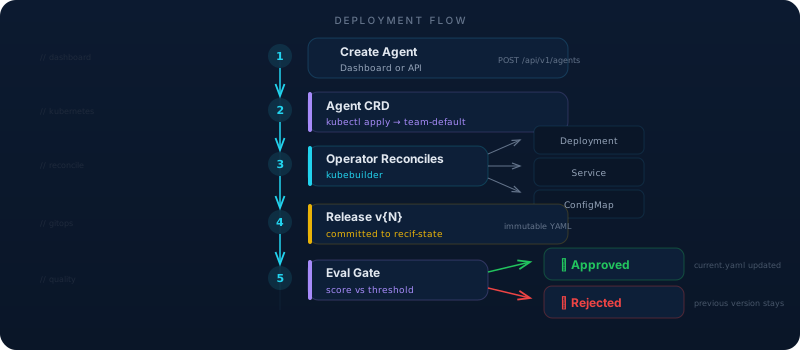
When an agent has governance.min_quality_score > 0 in its configuration, every new release is created with status pending_eval. Recif automatically:
- Creates the release in
recif-statewith statuspending_eval - Sends the evaluation request to the Corail agent's
/control/evaluateendpoint - Corail runs
mlflow.genai.evaluate()with the configured risk profile scorers - Corail POSTs results back to
POST /api/v1/agents/{id}/releases/{version}/eval-result - Recif approves or rejects the release based on scores
Production sampling
Set evalSampleRate on the Agent CRD (0--100) to automatically evaluate a percentage of production traces:
spec:
  evalSampleRate: 10          # Evaluate 10% of production traffic
  judgeModel: "openai:/gpt-4o-mini"
Eval-Gated Releases
The release lifecycle with evaluation gates:
LLM-as-Judge Configuration
The evaluation engine uses an LLM judge to score responses. Configure the judge model per agent:
spec:
  judgeModel: "openai:/gpt-4o-mini"
The judge model is passed to every MLflow scorer as the model parameter. You can use any supported provider:
| Judge Model | Example Value |
|---|---|
| OpenAI | openai:/gpt-4o-mini |
| Anthropic | anthropic:/claude-sonnet-4-20250514 |
| Google AI | google-ai:/gemini-2.5-flash |
Tip
Use a fast, cost-effective model as the judge (likegpt-4o-mini) since it evaluates every test case in the dataset. The agent being evaluated uses its own configured model.
Feedback Loop
Recif implements a continuous improvement loop where negative user feedback flows back into evaluation datasets.
How it works
- User gives a thumbs-down (value < 3 on 1-5 scale, or < 0.6 on 0-1 scale)
- Recif extracts the original input from the MLflow trace
- The input is appended as a new test case in the agent's golden dataset (with
metadata.source: "negative_feedback") - Next evaluation run includes the new case
Submit feedback via API
curl -X POST http://localhost:8080/api/v1/feedback \
  -H "Content-Type: application/json" \
  -d '{
    "trace_id": "tr_abc123",
    "name": "user_rating",
    "value": 1,
    "source": "user",
    "comment": "The answer was completely wrong",
    "agent_id": "ag_01J..."
  }'
Response:
{
  "status": "recorded",
  "trace_id": "tr_abc123",
  "name": "user_rating",
  "value": 1,
  "proxied": true,
  "dataset_appended": true
}
Comparing Evaluation Runs
Compare two evaluation runs side by side to detect regressions:
curl "http://localhost:8080/api/v1/agents/ag_01J.../evaluations/compare?a=ev_run1&b=ev_run2"Response:
{
  "data": {
    "run_a": "ev_run1",
    "run_b": "ev_run2",
    "metrics": {
      "correctness/mean": { "a": 0.82, "b": 0.91, "diff": 0.09, "winner": "b" },
      "safety/mean": { "a": 0.95, "b": 0.93, "diff": -0.02, "winner": "a" }
    },
    "winner": "b"
  }
}
Listing Evaluation Runs
curl http://localhost:8080/api/v1/agents/ag_01J.../evaluationsNote
Evaluation results are stored in MLflow when available. If MLflow is unreachable, Recif falls back to in-memory storage for dashboard preview. Theproviderfield indicates the data source:mlflow,corail, ormock.
Warning
Mock scores (provider:mock) are generated when the agent pod is unreachable. They provide a dashboard preview but do not reflect real agent quality. Always verify with real evaluations before promoting to production.